Case study
Google Privacy Governance Platforms and AI-Assisted Assurance
NDA-protected details. See more @safety.google
Why Governance Needed to Move at Product Speed
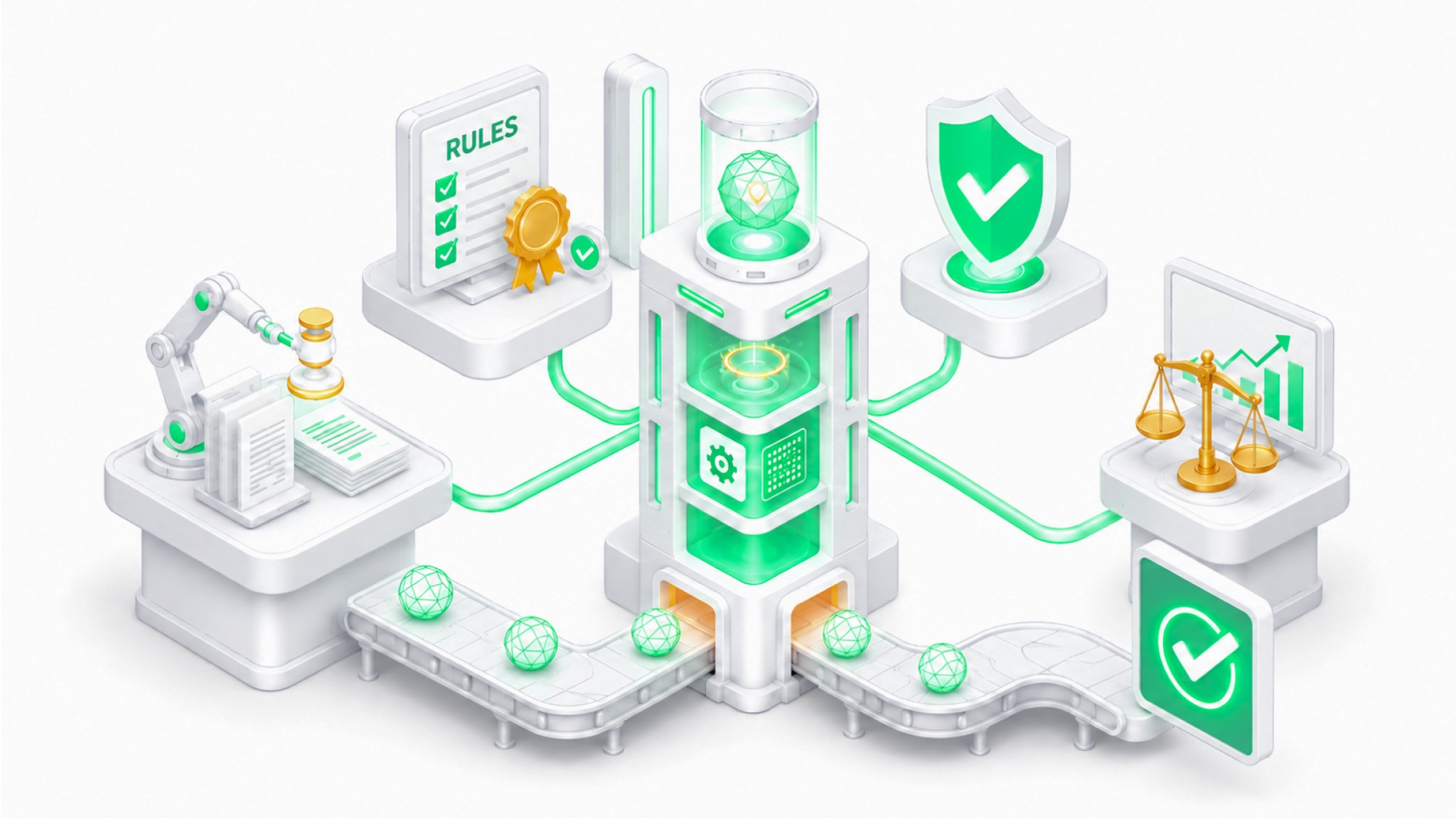
At Google scale, governance was not just a review step. It was part of how product teams launched responsibly while managing user-trust, legal, policy, regulatory, and business risk.
The work centered on GDPR-driven privacy review, with DMA and GenAI launch dimensions layered into the same operating model. A launch could involve new data-use patterns, sensitive data types, location awareness, child-user considerations, gatekeeper-service implications, GenAI features, model integrations, or customer-facing AI behavior.
That complexity made review hard to scale. Teams needed to launch quickly, but workflows were fragmented across tools, policies, Product Areas, Privacy Working Groups, Legal reviewers, and backend automation.
At this scale, governance could not depend on manual interpretation or disconnected review paths. Teams needed clearer ways to understand what applied, what evidence was required, who needed to review, and whether a launch was ready to move forward.
Before
Governance reviews depended on fragmented workflows, manual triage, inconsistent launch data, repeated clarification, and unclear ownership.
After
A clearer operating model connected intake, diagnostics, evidence capture, review collaboration, workflow automation, and launch readiness into a scalable platform.
My Role in the Platform Transformation
I helped transform governance from a fragmented review process into a more scalable platform experience—working across product, engineering, privacy, legal, compliance, AI, security, and program teams.
Early in the program, I delivered over a dozen feature improvements that streamlined workflows, reduced cruft and toil, simplified surfaces and touchpoints, and consolidated assessments by 65%.
My work centered on four priorities:
- Mapping the launch-review ecosystem across intake, diagnostics, documentation, review bugs, workflow automation, evidence capture, and launch readiness
- Improving the handoff between Privacy Working Groups and stricter Legal reviews for higher-risk launches
- Shaping AI-assisted assurance workflows for documentation quality, decision support, routing, review automation, and evidence quality
- Aligning senior cross-functional stakeholders around reusable UX patterns that could scale across regulatory domains, Product Areas, and launch types
The role required translating policy, legal, product, and engineering complexity into product experiences that helped teams move faster without losing accountability.
Mapping the Launch Review Ecosystem
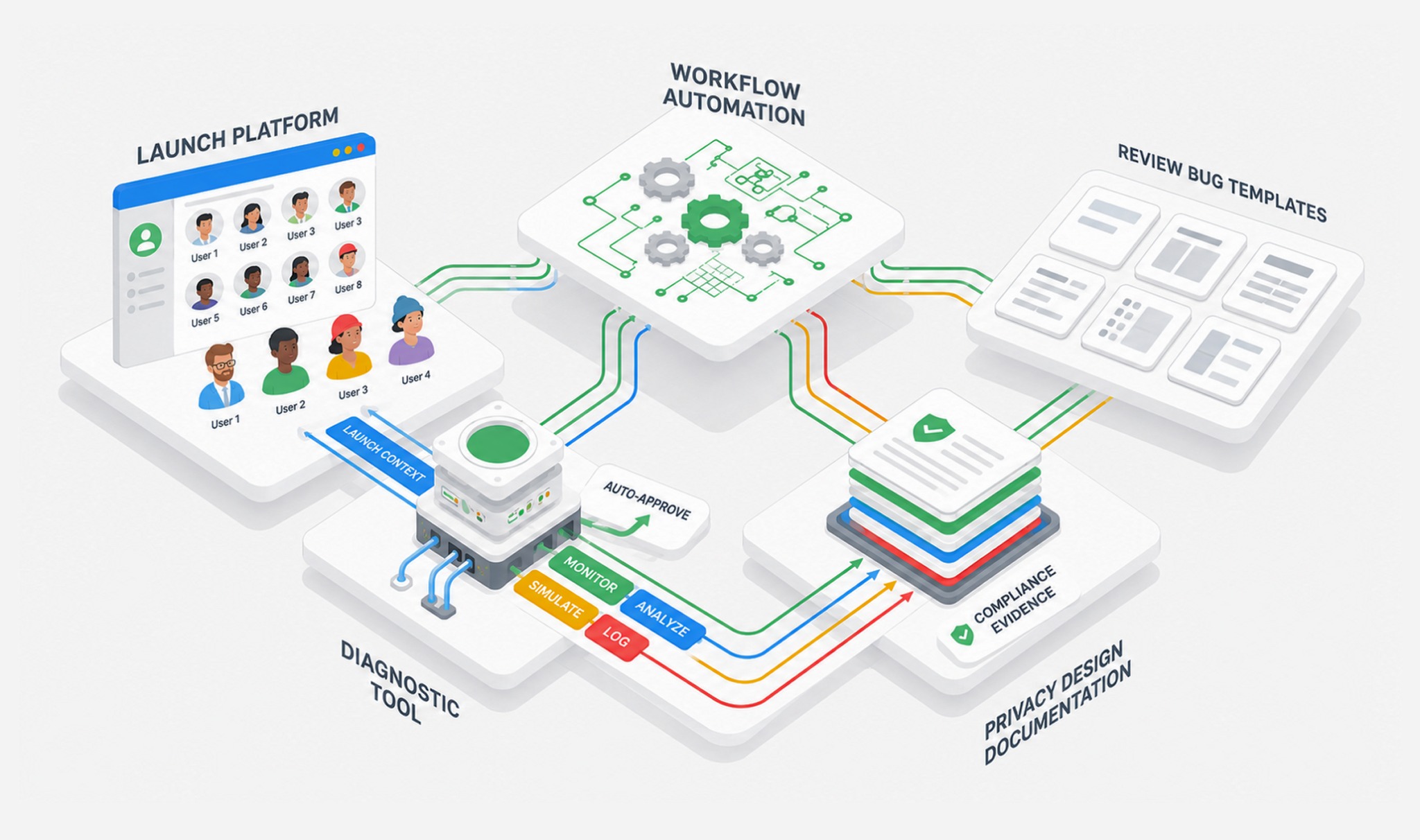
The launch-review workflow was not one tool. It was a five-surface governance ecosystem spanning the Launch platform, diagnostic tooling, privacy design documentation, review bug templates, and workflow automation.
Each surface solved a different part of the review problem.
- The Launch platform was the initial surface for launch reviews, including Privacy and Legal review areas.
- The diagnostic tool assessed launch implications and determined whether a launch could be auto-approved, needed light review, or required stricter Legal review.
- Privacy design documentation captured launch intent, supporting design and development artifacts, change severity, and compliance-ready evidence.
- Review bug templates organized requirements for launch teams and reviewer teams, making collaboration clearer and easier to advance.
- Workflow automation applied Product Area and horizontal review rules, supported role- and turn-based ownership, and surfaced missing artifacts, conflicts, or unresolved details.
Review quality hinged on the information moving through those surfaces. When launch context was incomplete or inconsistent, reviewers had to chase details, handoffs slowed down, and teams lost confidence in the process.
My work helped connect these surfaces into a clearer operating model—improving Privacy-to-Legal handoffs, reducing repeated clarification, and helping teams understand what was needed to advance or complete review.
Designing AI-Assisted Review and Diagnostic Routing
AI-assisted assurance became useful only after the workflow had stronger inputs. Before automation could work, the Launch surface needed better product, design, and development documentation; clearer change context; and stronger signals around missing information.
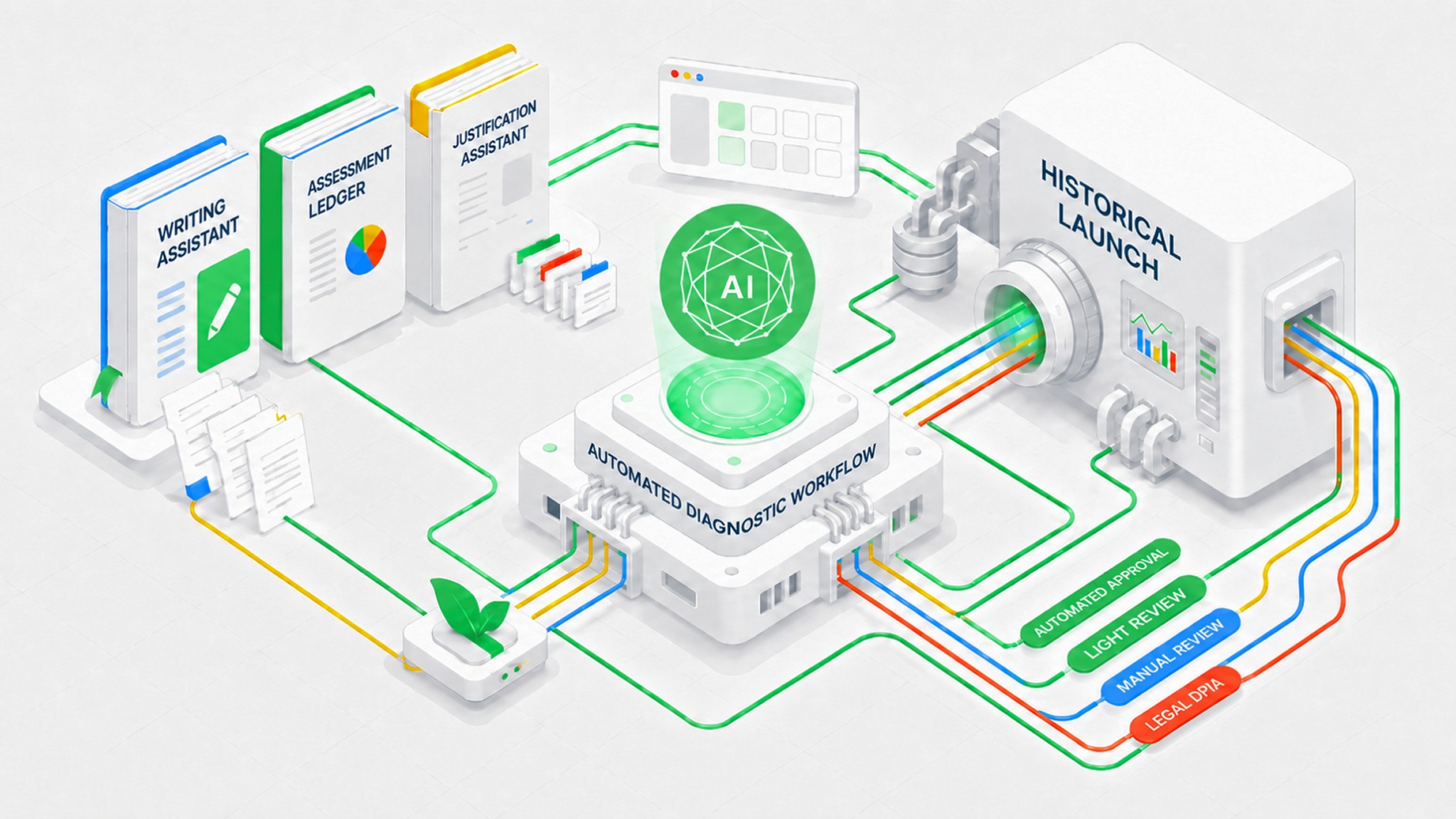
I helped design and land five AI-assisted capabilities that built on that foundation:
- A writing assistant for Privacy documentation assessments
- A documentation-review assistant that checked for accuracy, conflicts, and missing information
- A Gemini-powered Chrome extension that could reason across the five launch-review surfaces
- A justification-writing assistant for exceptions, review variance, and reviewer rationale
- An automated diagnostic flow that compared past launches with updated launch inputs to recommend auto-approval, light review, or stricter Legal review
The diagnostic flow was the most ambitious. It used stronger launch inputs and historical patterns to route review needs more accurately, while orchestrating context downstream to review bugs, reviewers, and follow-on workflow steps.
The goal was not a generic AI layer. It was a better assurance model—one that helped teams move earlier, reviewers decide with more confidence, and governance scale without losing accountability.
Key Product Decisions
Map the review ecosystem before redesigning it
The launch-review workflow spanned five connected surfaces, multiple reviewer groups, and several review paths. Before improving the experience, the work required understanding where review data moved, where handoffs broke down, and where teams lost confidence.
Improve Privacy-to-Legal handoffs
Higher-risk launches needed clearer handoffs between Privacy Working Groups and Legal reviewers, especially when launches involved sensitive data, location awareness, child users, GenAI behavior, or other elevated-risk contexts.
Build diagnostic routing around better inputs and evidence
The diagnostic tool needed to determine whether a launch could be auto-approved, needed light review, or required stricter Legal review—without hiding the evidence or rationale behind that decision.
Use AI assistance without removing accountability
AI-assisted workflows were most valuable when they improved signals, reduced repetitive work, and supported reviewer judgment—not when they obscured ownership or decision quality.
Platform and Operational Impact
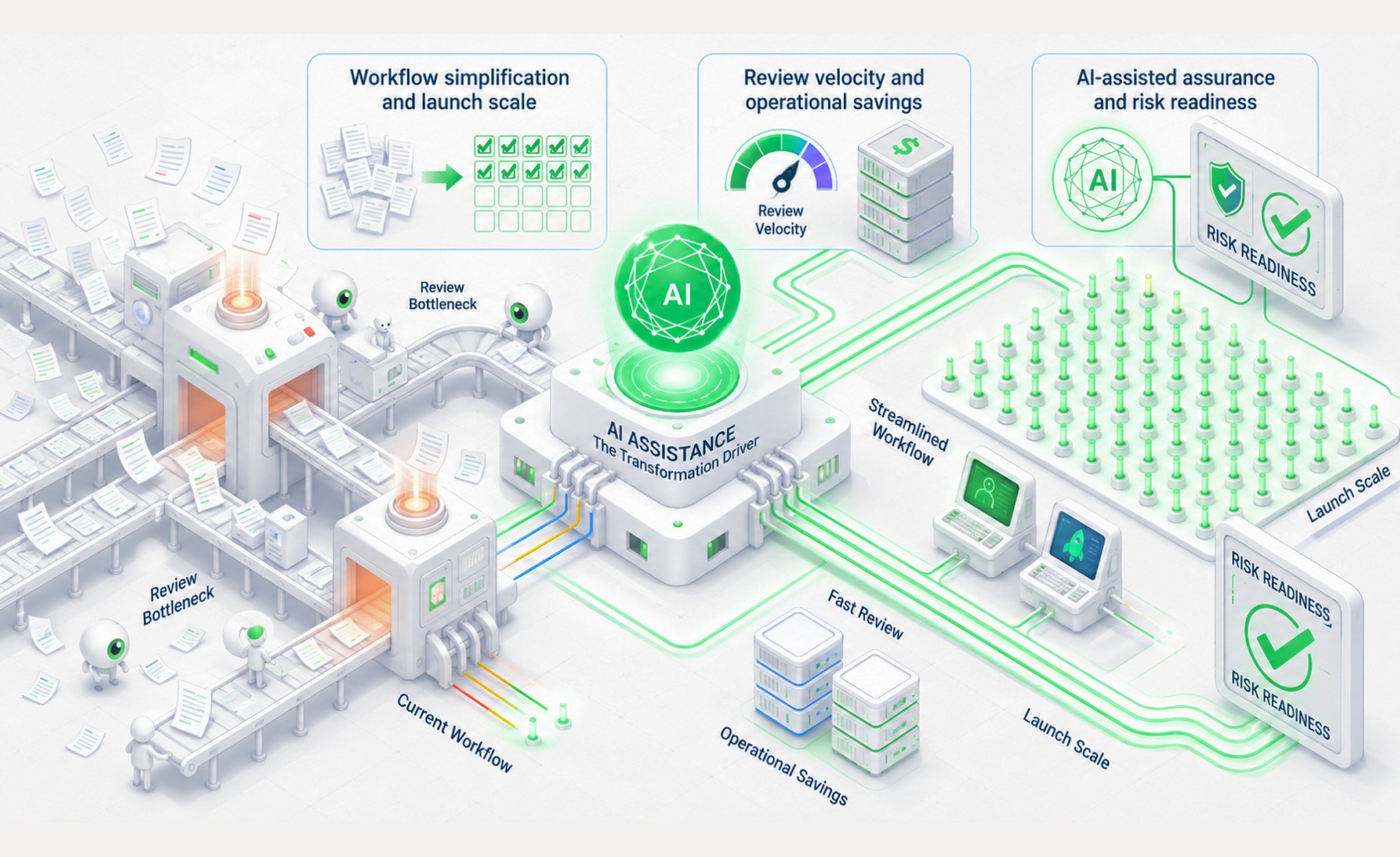
Workflow simplification and launch scale
Delivered over a dozen feature improvements that streamlined workflows, reduced cruft and toil, and consolidated assessments by 65%. The platform supported governance workflows for 50k annual product launches, helping teams navigate complex review requirements at enterprise scale.
Review velocity and operational savings
Reduced review time by 54% by improving workflow clarity, review routing, evidence capture, and platform support. These improvements contributed to an estimated $15M in annual operational savings by reducing review friction and improving governance efficiency.
AI-assisted assurance and risk readiness
Helped land AI-assisted workflows for writing support, documentation review, cross-surface sensemaking, justification writing, and diagnostic routing. The work improved consistency, evidence quality, accountability, and audit readiness across high-stakes launch review.
The strongest outcome was not only faster review. It was a more durable governance operating model that connected workflow simplification, AI-assisted support, reviewer judgment, risk routing, and launch readiness into a platform capability that could scale.
Reflection
This work reinforced that governance systems succeed when they help teams make better decisions faster. The goal is not to remove accountability. It is to make accountability easier to understand, act on, and scale.
The most reusable shift was treating governance as a platform experience—not a review queue. Given more time, I would deepen the relationship between product-team self-service, AI-assisted guidance, reviewer confidence, and measurable launch outcomes.